Book summary
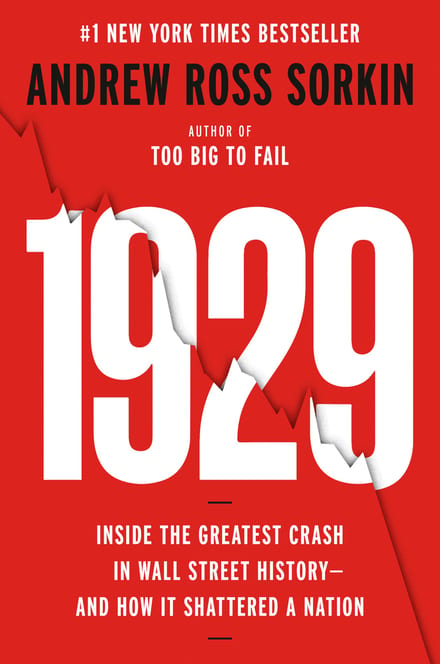
1929
Inside the Greatest Crash in Wall Street History--and How It Shattered a Nation
The full book runs ~592 pages — roughly 11 hours of reading. You get the key ideas here in 5 minutes.
The key ideas
- Debt fuels every major bubble, including 1929's credit frenzy
- Bankers rigged stock pools to fleece small investors
- Mitchell defied the Fed to keep speculation alive
- Pecora's hearings exposed tax dodges and insider self-dealing
- Glass-Steagall separated commercial banking from Wall Street gambling
- Lost credit and confidence turned the crash into Depression
The summary
Debt runs underneath every financial collapse, and 1929 is the clearest case study we have. Through the boom years, ordinary Americans bought cars, radios, and stocks the same way—on credit—and the country’s most trusted bankers didn’t just permit it. They built the machine, greased it, and talked people into climbing aboard. When the market finally broke that October, the men who had profited most spent years insisting it was nobody’s fault, until a Senate prosecutor proved otherwise and Congress rewrote the rules of American banking.
Credit was sold as a cure for everything
Thomas Lamont of J.P. Morgan captured the era’s faith when he said “there wasn’t a problem in the world that couldn’t be solved through the wizardry of credit.” His firm spun up speculative holding companies and quietly handed discounted shares to well-connected friends before the public could buy in. The logic beneath the boom was thinner than it looked: investors weren’t buying companies, they were buying reputations, betting that a famous name attached to a stock meant it could only rise.
That faith had a policeman, and its name was the Federal Reserve. When the Fed tried to choke off the margin lending pumping up the bubble, Charles Mitchell of National City Bank openly defied it. On March 26, with a sell-off threatening panic, he announced his bank would lend millions to keep speculators afloat. The market steadied within hours, and Washington was furious. Senator Carter Glass attacked Mitchell for “avowing one’s obligation to stock gambling as superior to one’s sworn obligation to his country.”
The pools were rigged from the inside
The real fortunes came from stock pools: groups of wealthy insiders who traded a stock among themselves to drive up its price, then dumped it on the public at the top. William Durant made his money exactly this way, fleecing the small investors who chased the momentum he manufactured. In late March, Michael Meehan ran a pool on RCA shares, feeding off the country’s obsession with radio, and the insiders walked away with roughly $5 million in a little over a week. None of it produced anything. It simply moved money from the naive to the connected.
The bottom fell out in two days
Warnings came and were waved off. Economist Roger Babson predicted a crash in early September; Lamont privately told his son to hold cash because “cash is a good asset.” John Raskob, unveiling a model of the Empire State Building, told fellow financiers that a country able to build such a thing “surely cannot be allowed to crash.” Then it did. Black Thursday hit on October 24. Wall Street’s leading bankers pooled their money for a showy rescue, and Richard Whitney bought US Steel above market price, earning the nickname “White Knight of Wall Street.” It held for three days. On Black Tuesday the panic returned and swamped the bankers’ pool. National City accidentally bought 71,000 of its own collapsing shares. Jesse Livermore, who had bet on ruin, made a fortune. James Riordan, wiped out by margin calls, shot himself, and his partners delayed reporting his death while they begged the Fed for cash. Hoover offered reassurances and nothing else.
Pecora dragged it into the light
The market recovered some ground, but the loss of credit and confidence was already curdling into the Great Depression, and public patience with Wall Street ran out. In February 1933, prosecutor Ferdinand Pecora put Mitchell in front of the Senate and took him apart. He exposed Mitchell’s enormous pay and his trick of selling stock to his wife to dodge income tax. Worse, he revealed that after the crash National City set up a $2.4 million fund so top executives could borrow to buy company stock—loans quietly shifted off the books and never repaid—while low-level employees “were forced to keep making payments toward the full purchase price,” and lost their jobs if they fell behind. Mitchell resigned in disgrace, was indicted for tax evasion, and was later acquitted on the argument that his dodge had been legal. The hearings moved to J.P. Morgan, where partners turned out to have paid no income tax at all and to have handed discounted shares to political insiders. Years later the “White Knight,” Richard Whitney, was caught stealing from the New York Stock Exchange and sent to prison.
On June 16, 1933, Roosevelt signed the Glass-Steagall Act, splitting commercial banking from Wall Street speculation and insuring deposits up to $2,500. It was an admission that the crash had been preventable all along.
The bottom line
1929 wasn’t bad luck. It was the logical outcome of a system where the most respected bankers pushed credit and speculation onto people who couldn’t afford the fall, then fought every attempt to slow them down. Read this if you want to see how debt-fueled bubbles get built, who builds them, and why the wall between ordinary banking and market gambling exists.
Fact check
Popular books repeat findings that later research has complicated. Where 1929 makes a testable claim, here's what the evidence actually shows.
The 1929 crash was engineered by reckless bankers pushing credit and rigged stock pools, rather than caused by monetary policy or wider economic forces.
The margin lending and insider pools the book documents were real, but economic historians put Federal Reserve policy near the centre of the 1929 break. The Fed raised its discount rate from 3.5% to 5% between January and July 1928 and to 6% by August 1929 in a deliberate attempt to puncture the stock boom, leaving a real discount rate around 6%. Valuations were high but not extreme: the price-dividend ratio at the September 1929 peak was 32.8 against a long-run average of 25, below levels later reached in the 1960s and 1990s. The recession had also begun in August 1929, before the crash.
- Cogley T. Monetary policy and the great crash of 1929: a bursting bubble or collapsing fundamentals? FRBSF Economic Letter. March 26, 1999. Source
- Bordo MD, Landon-Lane J. The lessons from the banking panics in the United States in the 1930s for the financial crisis of 2007-2008. Paper prepared for a seminar at the Graduate Center, CUNY; February 7, 2012. Source
The loss of credit and confidence after the October 1929 crash is what turned a market break into the Great Depression.
The credit-and-confidence mechanism is right, but the damage was done by the bank runs of 1930-33 rather than by the crash itself. Friedman and Schwartz attributed the contraction from 1929 to 1933 to a collapse of the money supply by about one third, as depositors shifted from deposits to currency and the Federal Reserve failed to supply liquidity. Revisiting the debate with data on why individual banks failed, Bordo and Landon-Lane find illiquidity shocks played a key role in the failures during those panic windows. The October 1929 crash was the opening event, not the transmission mechanism.
- Bordo MD, Landon-Lane J. The lessons from the banking panics in the United States in the 1930s for the financial crisis of 2007-2008. Paper prepared for a seminar at the Graduate Center, CUNY; February 7, 2012. Source
Roosevelt signed the Glass-Steagall Act on June 16, 1933, insuring bank deposits up to $2,500.
Both the date and the dollar figure are right. Roosevelt signed the Banking Act of 1933 on June 16, and its temporary insurance plan took effect on January 1, 1934 with $2,500 of coverage per depositor; protection then doubled to $5,000 for commercial bank depositors on July 1, 1934. The stabilising effect was immediate — nine banks failed in 1934, against more than 9,000 in the preceding four years.
- Federal Deposit Insurance Corporation, Division of Research and Statistics. A Brief History of Deposit Insurance in the United States. Washington, DC: FDIC; September 1998. Source
Frequently asked questions
What is 1929 about?
It presents the 1929 crash as the clearest case study we have of how debt-fueled bubbles get built, showing that America's most trusted bankers didn't just permit reckless credit and speculation, they built the machine and talked people onto it. When the market broke, the men who profited spent years denying fault until a Senate prosecutor proved otherwise and Congress rewrote banking law.
What are the key takeaways from 1929?
Credit was sold as a cure for everything, and investors were really buying reputations rather than companies. Rigged stock pools let insiders trade a stock among themselves and dump it on the public, as with the RCA pool that netted about $5 million in a week. Warnings from figures like Roger Babson were waved off before Black Thursday and Black Tuesday swamped even the bankers' rescue. Ferdinand Pecora's 1933 hearings exposed Charles Mitchell's tax dodges and the loans National City hid off its books. The story ends with the Glass-Steagall Act splitting commercial banking from Wall Street speculation and insuring deposits.
Who should read 1929?
It's for anyone who wants to see how debt-fueled bubbles get built, who builds them, and why the wall between ordinary banking and market gambling exists in the first place.
Is 1929 worth reading?
It shines at naming names and following the money, from Lamont and Mitchell to the Pecora hearings, so the crash reads as a preventable outcome rather than bad luck. Readers wanting broad economic theory or the full arc of the Great Depression should know the focus stays tight on the bankers, the boom, and the reckoning that followed.