Book summary
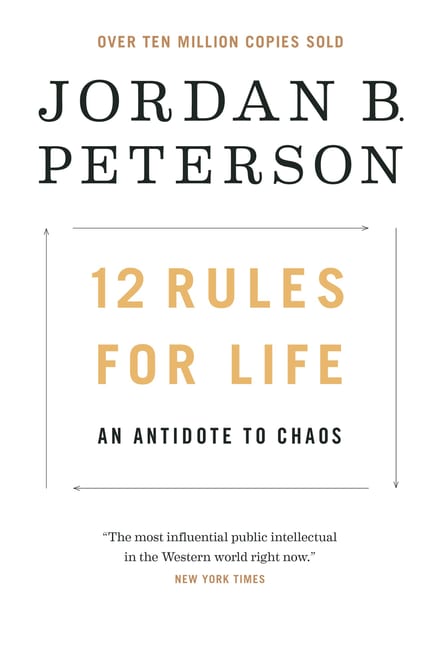
12 Rules for Life: An Antidote to Chaos
The full book runs ~480 pages — roughly 9 hours of reading. You get the key ideas here in 4 minutes.
The key ideas
- Stand up straight—posture signals competence and shifts your status
- Surround yourself with people who push you upward
- Treat yourself as someone you're responsible for helping
- Compare yourself to who you were yesterday, not others
- Speak precisely and truthfully; abandon comforting life-lies
- Pursue meaning through sacrifice, not instant gratification
The summary
Life is hard and the world is unfair. Peterson takes that as a starting point, not a complaint. His whole argument is that protesting the injustice of things won’t fix your life, but taking responsibility for it might. You don’t tear down the hierarchy or wait for the world to accommodate you. You stand up straight, tell the truth, and become a little better than you were yesterday. What follows are twelve rules, but they all point the same direction: order is something you build, one deliberate act at a time.
Hierarchies are real, so hold your ground in them
The phrase “pecking order” is literal. When feed arrives, the healthiest, strongest chickens eat first, and every animal society runs on some version of that ranking, humans included. We read physical bearing as a proxy for capability, which is why standing up straight with your shoulders back actually makes you seem more competent. That perception feeds back on itself: people treat you as if you belong higher up, and you start to act like it. Posture isn’t vanity. It’s a signal that nudges your position on the ladder.
Who you spend time with works the same way. Studies of workplaces found that dropping an underperformer among high performers didn’t lift the underperformer. The high performers picked up the bad habits and their own work declined. Decline is contagious. A good friend won’t let you wallow in negativity, and won’t drift down with you. Choose people who want you to do well and expect the same back.
Treat yourself like someone worth helping
People faithfully follow the vet’s instructions for their pets, yet a third of us ignore the prescriptions our own doctors write. We look after animals better than ourselves. The reason is a quiet self-loathing. We’re conscious of our flaws in a way our pets never are, and out of that comes a sense that we don’t quite deserve to feel good, so we punish ourselves through neglect.
The correction is to care for yourself the way you’d care for someone you love. That isn’t the same as doing whatever feels easiest or most pleasant in the moment. Children brush their teeth not because they enjoy it but because it needs doing, and the same distinction holds for adults. Ask what’s genuinely good for you, then do that, even when comfort argues otherwise.
Measure yourself against yesterday, and say what’s true
Compare yourself to other people and you’ve entered a game you can’t win. Someone will always be ahead of you on some axis, often because of circumstances that were never yours to control. When success becomes win-or-lose against others, you stop noticing your own incremental progress. Self-criticism is useful, but only when it’s aimed at your former self. The real question is whether you’re further along than you were yesterday.
Truth is the other half of this. Nietzsche said a person’s strength can be measured by how much undiluted truth they can bear. Alfred Adler named the opposite tendency the “life-lie,” an unrealistic goal we cling to instead of facing reality, and living by one steers you into consequences you didn’t choose. Precision helps: you describe your symptoms clearly so a doctor can diagnose you, and you should be just as exact when your spouse upsets you, rather than hinting or sulking. In the same spirit, treat a conversation as a chance to learn instead of a contest to win. Socrates was called wise because he admitted he knew nothing, which left him open to everyone. Listen, restate what the other person said, and let yourself be wrong sometimes.
Shoulder your own life before you blame the world
Aleksandr Solzhenitsyn fought the Nazis as a communist, then was thrown into a Soviet gulag by his own state after the war. He didn’t sink into the unfairness of it. He wrote The Gulag Archipelago, which chronicled the camps, drained Stalin’s support around the world, and is now required reading in Russian schools. He couldn’t control his imprisonment. He could control what he made of it. There will always be injustice, and there will always be some way for you to improve your own corner of things.
Responsibility extends to raising children. Kids are born with aggressive instincts, and a parent’s job is to shape them into something functional, because children who don’t learn responsibility at home learn it later in harsher ways that involve no love. Keep the rules few and simple, use the least force needed to correct misbehavior, make consequences clear, and parent as a united pair. And when kids are skateboarding, leave them be. They’re practicing the drive to face fear and danger that has pushed human progress forward.
Pursue meaning, and don’t miss the small joys
Doing what’s right almost always costs more than doing what’s expedient. Give in to instant gratification and you build the habits that ruin people, from binge eating to alcoholism to drug abuse. Real success asks for sacrifice now in exchange for something later, like the lotus that begins in the dark mud at the bottom of a lake and climbs, methodically, until it breaks the surface and blooms.
And life is genuinely painful. Peterson’s daughter has lived with severe arthritis since she was six, through constant pain and repeated surgeries. It’s precisely because of suffering like that, he argues, that small joys carry so much weight. When you love someone, it isn’t in spite of their limitations but because of them. So if a street cat crosses your path, stop and pet it. That moment of solace is not nothing.
The bottom line
Order doesn’t arrive by fixing the world; it grows out of the responsibility you’re willing to shoulder in your own life. Stand up straight, speak precisely, aim at meaning over comfort, and keep company with people who want you to succeed. Read this if you feel stuck and suspect the way out runs through the hard things you’ve been avoiding.
Fact check
Popular books repeat findings that later research has complicated. Where 12 Rules for Life makes a testable claim, here's what the evidence actually shows.
Standing up straight with your shoulders back makes you read as more competent and nudges your actual position in the hierarchy.
The self-directed half is weaker than the popular version. Carney, Cuddy and Yap's 2010 study of 42 people reported that expansive poses raised testosterone, lowered cortisol and increased risk-taking; a 200-person replication recovered the subjective feeling of power but found no hormonal or risk-tolerance effect. A meta-analysis of 73 experiments then found the dependable difference comes from not collapsing inward rather than from expanding outward: contractive versus neutral postures gave Hedges's g = 0.45, expansive versus neutral only g = 0.06. Slouching costs you something real; the upright pose adds little on top of an ordinary neutral one.
- Carney DR, Cuddy AJ, Yap AJ. Power posing: brief nonverbal displays affect neuroendocrine levels and risk tolerance. Psychol Sci. 2010;21(10):1363-8. PubMed
- Ranehill E, Dreber A, Johannesson M, Leiberg S, Sul S, Weber RA. Assessing the robustness of power posing: no effect on hormones and risk tolerance in a large sample of men and women. Psychol Sci. 2015;26(5):653-6. PubMed
- Elkjaer E, Mikkelsen MB, Michalak J, Mennin DS, O'Toole MS. Expansive and contractive postures and movement: a systematic review and meta-analysis of the effect of motor displays on affective and behavioral responses. Perspect Psychol Sci. 2022;17(1):276-304. PubMed
Human status hierarchies run on the same ranking mechanism as the animal pecking order.
Dominance is one route up, not the only one. Cheng and colleagues watched hierarchies form among strangers and found prestige, meaning sharing expertise to earn respect, won as much perceived influence, actual influence over others' behavior, and visual attention as dominance did, with one asymmetry: prestigious people were liked and dominant ones were not. Henrich and Gil-White argue prestige is a separate mechanism resting on cultural transmission, deference freely given rather than extracted by force, with no clean counterpart in a chicken's pecking order. The hierarchy is real; the single biological ladder is not.
- Cheng JT, Tracy JL, Foulsham T, Kingstone A, Henrich J. Two ways to the top: evidence that dominance and prestige are distinct yet viable avenues to social rank and influence. J Pers Soc Psychol. 2013;104(1):103-25. PubMed
- Henrich J, Gil-White FJ. The evolution of prestige: freely conferred deference as a mechanism for enhancing the benefits of cultural transmission. Evol Hum Behav. 2001;22(3):165-196. PubMed
About a third of people ignore the prescriptions their own doctors write, even though they follow the vet's instructions for their pets.
The pooled estimate is closer to a quarter. DiMatteo's meta-analysis of 569 studies published between 1948 and 1998 put the average nonadherence rate at 24.8%. Linking 150,565 new prescriptions in British Columbia to dispensing records found 17% were never filled at all, rising to 35.1% for as-needed drugs such as topical corticosteroids. Nonadherence is a large, well-documented problem and Peterson's point survives it; the specific one-in-three figure sits above the central estimate, and the pet-versus-self comparison has no measured basis.
- DiMatteo MR. Variations in patients' adherence to medical recommendations: a quantitative review of 50 years of research. Med Care. 2004;42(3):200-9. PubMed
- Zeitouny S, Cheng L, Wong ST, Tadrous M, McGrail K, Law MR. Prevalence and predictors of primary nonadherence to medications prescribed in primary care. CMAJ. 2023;195(30):E1000-E1009. PubMed
Dropping a weak performer into a team of strong ones drags the strong performers down rather than lifting the weak one.
Workplace data points the other way. Mas and Moretti tracked high-frequency checkout productivity at a large supermarket chain and found strong positive spillovers when highly productive staff were introduced into a shift, with the gain concentrated among workers who could be seen by the newcomer and absent among those who could not, which implicates social pressure rather than habit contagion. The bad-apple work this claim leans on is a theoretical review of how one persistently negative member can disrupt a group's functioning, which is a different proposition from a team's competence sinking to the level of its weakest member.
Frequently asked questions
What is 12 Rules for Life about?
It starts from the premise that life is hard and the world is unfair, then argues that protesting the injustice won't fix your life but taking responsibility for it might. The twelve rules all point one way: order is something you build through deliberate acts, starting with your own corner of things.
What are the key takeaways from 12 Rules for Life?
Stand up straight, because posture is a signal that nudges your place in real hierarchies. Treat yourself like someone worth helping, and choose friends who want the best for you, since decline is contagious. Compare yourself to who you were yesterday instead of to other people, and tell the truth to avoid the "life-lie." Listen as if the other person might teach you something. Shoulder your own life before blaming the world, using figures like Solzhenitsyn as proof. Pursue meaning over expedient gratification, and don't miss the small joys, like petting a cat, that make suffering bearable.
Who should read 12 Rules for Life?
It's for anyone who feels stuck and suspects the way out runs through the hard things they've been avoiding.
Is 12 Rules for Life worth reading?
It does well at pairing blunt personal-responsibility advice with vivid stories and a serious reckoning with suffering, which gives the rules real weight. Its meandering, discursive style and the way each short rule spirals into long tangents on psychology and myth won't suit readers who want tight, actionable steps.