Book summary
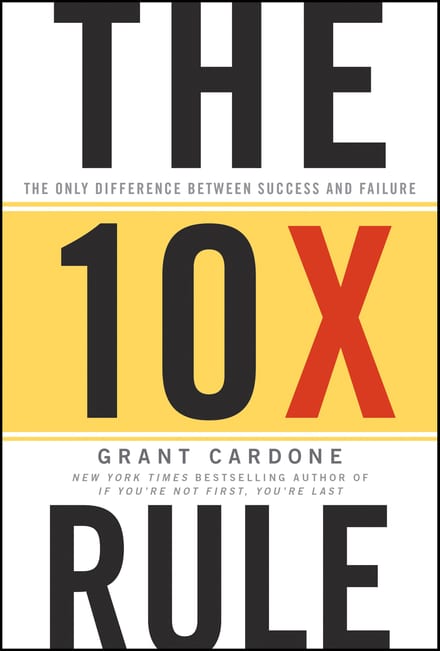
The 10X Rule: The Only Difference Between Success and Failure
The Only Difference Between Success and Failure
The full book runs ~256 pages — roughly 5 hours of reading. You get the key ideas here in 5 minutes.
The key ideas
- Multiply your estimate: his first business took three years, not three months.
- Never lower a target — raise the activity until the market answers.
- Pick the fourth gear: doing nothing, retreating and average all burn energy too.
- Fight obscurity, not rivals — nobody knowing you is the real constraint.
- Treat fear as a green light and criticism as evidence you're being noticed.
- Write goals down morning and night, worded as if already achieved.
The summary
Most people don’t fail because they picked the wrong target. They fail because they were off by an order of magnitude about what hitting it would cost. Grant Cardone’s argument fits in a line: set targets ten times bigger than what you think you want, then take ten times the action you think they’ll require.
He credits everything he has to the second half and regrets the first. For every presentation, phone call, or appointment other people made, he made ten. But his goals stayed the size his upbringing had set them, and he calls that the biggest regret of his life — thirty years of getting the effort right while aiming at what everyone else considered reasonable. Underneath both halves sits a claim that sounds strange until you sit with it: success isn’t an option, it’s a duty — an ethical obligation to your family and your future. Treat it as optional and you’ll spend your life explaining why it never arrived.
The target is never the problem
Cardone started his first business at 29 and budgeted three months to get back to the income of the job he’d left. It took almost three years — twelve times his estimate — and he nearly quit at month three, reasons lined up: no money among the clients, a bad economy, bad timing. Then he noticed the one variable he’d never questioned. He went from two or three sales calls a day to twenty or thirty, and the market started answering. Ten times the effort got him about four times the results, which he took as a fair trade.
The rule he pulled out of that matters more than the arithmetic: never reduce a target, increase actions. He’s watched sales managers do the opposite for twenty years — agree on a quota, miss it midway through the quarter, then move the finish line so the team still wins something. All that teaches anyone is that targets are negotiable. His own countermeasure: rewrite the goals every morning and night, worded as though already reached.
Four degrees of action, and three of them cost you anyway
Everyone operates at one of four levels: do nothing, retreat, act normally, or act massively. Cardone’s sharpest point is that all four burn energy. It takes work to stay in bed, to lose a job for lack of production, to explain again why you got passed over. People who swear off the stock market spend as much fuel defending the retreat as a successful person spends building something. If it costs you either way, spend it moving forward.
Normal is the dangerous one, because everyone signs off on it. Average action builds an average marriage, career and savings, and holds up fine right until conditions change — which they always do. The numbers, without sympathy: the average worker reads less than one book a year and works 37.5 hours a week, while the top U.S. CEOs claim to read more than sixty and make 319 times as much.
Massive action looks unreasonable from outside, and that’s the tell. Building his seminar business, Cardone started at 7 AM and got back at 9 PM, cold-visiting up to forty companies a day; in El Paso, where he knew nobody, he’d covered every business in the market inside two weeks. A real estate agent who shadowed him quit after three days: “I am only riding with you, and I’m exhausted.” Two signs tell you you’re at this level — you generate new problems, and people warn you to slow down.
Your only problem is obscurity
Stop competing and start dominating, Cardone says: watching a rival is a way of letting them set your pace. Nobody knows you exist; that’s the real constraint, not talent. When he first tried social media he posted twice a day, then multiplied it — emails from monthly to twice a week, forty-eight tweets a day, one every thirty minutes. The unsubscribes he’d been warned about never spiked; admiration did.
Do what your industry won’t — his “only practices.” One client’s competitors never called customers who left without buying, so its managers started phoning people on the way out of the parking lot: nearly half came back immediately, and around eighty percent of those bought that day. When 2008 pushed everyone into contraction, he cut his own salary rather than his promotion budget, spending more on marketing in eighteen months than in the prior eighteen years. And customer satisfaction is the wrong target: across 500-plus mystery-shopped locations, 63 percent never presented the shopper with a proposal. You cannot satisfy a customer you never acquired.
Fear tells you where to go
Fear here is a green light, not a stop sign. What feeds it is time. The salesperson who dreads a call and gets a coffee first is feeding the fear the only thing it eats; take time out of the equation and call now. Preparation at that stage is usually a politer word for stalling.
Criticism behaves the same way. Once you start hitting it big, people who aren’t taking action will explain why what you’re doing is wrong, dressed up as concern that you should enjoy life more. It precedes admiration; the only answer worth giving is more success.
The bottom line
The gap between what you want and what you get is usually a math error about effort, and the correction is never a smaller goal — it’s ten times the action. Everything else here exists to stop you quietly negotiating your targets downward. Read it if you already work hard and suspect you’re aiming too low. Skip it if you want nuance: the doctrine that nothing happens to you, only because of you, gets stretched until you’re accountable for the driver who rear-ended you, and the prose is a loud, repetitive pep talk that rewards skimming.
Fact check
Popular books repeat findings that later research has complicated. Where The 10X Rule makes a testable claim, here's what the evidence actually shows.
The average worker reads fewer than one book a year.
Pew Research Center's survey of U.S. adults, fielded January 25 to February 8, 2021, found 75% had read at least one book in the previous 12 months, with a median of 5 books and a mean of roughly 14. The quarter who read nothing at all is the real gap Cardone is pointing at, but the population figure is several books a year, not under one.
- Faverio M, Perrin A. Three-in-ten Americans now read e-books. Pew Research Center. January 6, 2022. Source
A missed target means you needed more action, never a smaller goal, so targets should only ever be raised.
The first half holds up well: Locke and Latham's review of 35 years of goal-setting research found specific, difficult goals reliably produce higher performance than vague or easy ones, across hundreds of studies. What the same literature adds is a cost side the rule leaves out. Ordonez and colleagues document how aggressive stretch goals narrow attention onto the measured target, push people toward riskier bets, and raise unethical reporting when the number is about to be missed, which is exactly the moment the rule tells you to hold the target and add activity.
- Locke EA, Latham GP. Building a practically useful theory of goal setting and task motivation. A 35-year odyssey. Am Psychol. 2002;57(9):705-17. PubMed
- Ordonez LD, Schweitzer ME, Galinsky AD, Bazerman MH. Goals gone wild: the systematic side effects of overprescribing goal setting. Acad Manag Perspect. 2009;23(1):6-16. Source
Wording your written goals as though you had already achieved them is what makes the twice-daily goal-writing habit work.
The already-achieved framing is the part the evidence runs against. Oettingen and Mayer followed graduates job-hunting, students with a crush, undergraduates facing an exam and patients recovering from hip replacement for weeks to two years, and found the two ways of picturing the future pull in opposite directions: positive expectations, meaning judging success likely, predicted more effort and better outcomes, while positively experienced fantasies of the outcome already attained predicted less effort and worse results. Writing goals down is fine; savoring them as accomplished is what drains the effort.
- Oettingen G, Mayer D. The motivating function of thinking about the future: expectations versus fantasies. J Pers Soc Psychol. 2002;83(5):1198-212. PubMed
Ten times the action, sustained through 7 AM to 9 PM days, is what turns an average result into an outsized one.
More hours do buy more output, but the return flattens and the cost is measurable. Pencavel's analysis of munitions workers found output rose in step with hours below roughly 48 to 49 a week and only at a decreasing rate above that threshold, so each hour past it bought progressively less. WHO and ILO jointly attribute 745,194 deaths from ischemic heart disease and stroke in 2016 to working 55 or more hours a week, the schedule 8.9% of the world's workers were on. Cardone is right that effort is the variable most people never touch; the linear payoff he implies is not what the data shows.
- Pencavel J. The productivity of working hours. Econ J. 2015;125(589):2052-2076. Source
- Pega F, Nafradi B, Momen NC, et al. Global, regional, and national burdens of ischemic heart disease and stroke attributable to exposure to long working hours for 194 countries, 2000-2016: A systematic analysis from the WHO/ILO Joint Estimates of the Work-related Burden of Disease and Injury. Environ Int. 2021;154:106595. PubMed
Frequently asked questions
What is The 10X Rule about?
Grant Cardone argues that people rarely fail because they chose the wrong goal. They fail because they underestimated by an order of magnitude what reaching it would cost. His fix is a single rule applied twice: set targets ten times bigger than what you think you want, then take ten times the action you think they'll require.
What are the key takeaways from The 10X Rule?
Never reduce a target — increase the actions instead, because the target is almost never the real problem. There are four degrees of action (do nothing, retreat, act normally, act massively) and all four burn energy, so spend it moving forward; average is the most dangerous level because everyone approves of it. Your real constraint is obscurity rather than talent or competition, which is why Cardone pushes domination over competing and customer acquisition over customer satisfaction. And fear and criticism are indicators that you're moving, not signals to stop.
Who should read The 10X Rule?
It suits people who already work hard and suspect their goals are the thing holding them back — founders, salespeople, and anyone building something from a standing start with no name recognition. It's a book about volume and nerve, not technique.
Is The 10X Rule worth reading?
It's worth it for the central correction, which is genuinely useful: when a plan stalls, raise the activity before you lower the goal. Cardone backs it with his own numbers — a first business that took three years instead of the three months he'd budgeted, forty cold visits a day, forty-eight posts a day. But the prose is a loud, repetitive pep talk that rewards skimming, and the doctrine that nothing happens to you, only because of you, gets stretched far past where most readers will follow it.