Book summary
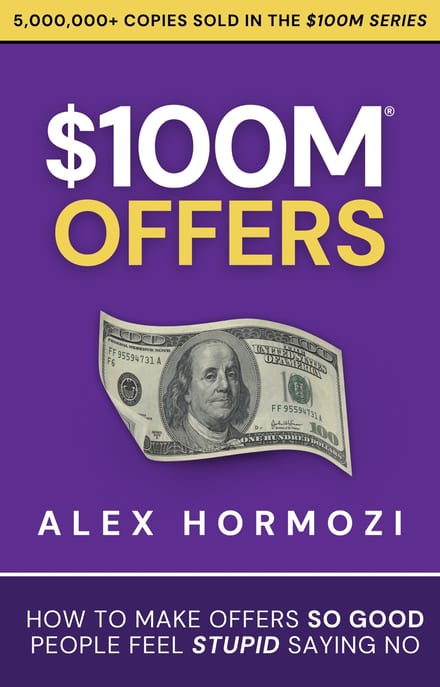
$100M Offers: How to Make Offers So Good People Feel Stupid Saying No
How to Make Offers So Good People Feel Stupid Saying No
The full book runs ~164 pages — roughly 3 hours of reading. You get the key ideas here in 5 minutes.
The key ideas
- Refuse to be a commodity — discounting is a spiral, not a strategy.
- Pick a market in pain with money, easy to reach and growing.
- Narrow three or four levels down; specific offers command premiums.
- Push all four levers: dream outcome, likelihood, time, effort.
- List every problem, turn each into a solution, then trim and stack.
- Add scarcity, urgency, bonuses and guarantees only at the end.
The summary
Two businesses sell roughly the same thing. One is being ground down over a ten percent discount; the other has a waiting list at four times the price. Alex Hormozi’s explanation is that the second one doesn’t have a better product — it has an offer that can’t be compared to anything else, which takes price out of the conversation entirely. He calls it a Grand Slam Offer, and the book is a construction manual for building one.
Discounting is a spiral, not a strategy
The warning he repeats hardest is against being a commodity — something a buyer can price-match. The book runs it as a cycle: cut your price and the perceived value of what you’re selling drops, so clients’ results drop, so the money you have left to serve them shrinks. Raise the price and every arrow flips — you can outspend your competition, serve people better, and hire better talent. His instruction is blunt — be more expensive than everyone else, by enough that the buyer pauses.
The arithmetic is why he’s willing to be that blunt. A business making $50 profit on a $100 sale needs 190 customers to clear $9,500. A business making $9,500 on a $10,000 sale needs one. Pitch the premium version to those same 190 people, close five percent — nine or ten sales — and you’ve made roughly nine times the profit from a twentieth of the customers.
Nothing rescues a market that isn’t hungry
Before any of that, you choose who you’re selling to, and Hormozi treats this as the decision that outranks both offer-building and sales skill. His four filters: the market is in pain, has purchasing power, is easy to target, and is growing. Convenience — a market you happen to know, or one that’s nearby — isn’t on the list.
Then narrow, three or four levels deep. His worked example runs health, then weight loss, then weight loss for women who have just had kids, then doing it on keto. Narrowing feels like shrinking the opportunity. His argument is the opposite: the specific offer to a specific person is the one that can charge a premium, because nothing else is shaped like it.
Four levers on perceived value
The engine of the book is the value equation, and it’s worth stealing even if you skip everything else. Value rises when the dream outcome and the perceived likelihood of reaching it rise, and when the time and effort it takes fall:
- Dream outcome — solve a problem that’s actually worth solving to them.
- Perceived likelihood of achievement — what testimonials and case studies are really for. Belief that it will work for them is a lever, not decoration.
- Time delay — how fast the result arrives, and whether you can show progress before it does.
- Effort and sacrifice — how much they have to do, give up, or figure out alone.
Most people push only the first, promising a bigger outcome. The bottom two are usually cheaper to improve and more convincing.
Build from problems, then wrap it
The construction process is mechanical, which is its virtue. Write down the customer’s dream outcome. List every obstacle between them and it — every step, everything that happens before and after, and the next problem they’ll hit once they succeed. Turn each problem into a solution. Then decide how each solution gets delivered, using what he calls the Delivery Cube: one-to-one, small group, or one-to-many; do-it-yourself, done-with-you, or done-for-you; support channel, format, speed. One good prompt sits inside it — what would you deliver if this cost ten times as much, and what if it cost a tenth and still had to be worth more?
Then trim and stack. Cut anything that isn’t high value to the customer, keep only a handful of expensive-to-deliver pieces, and fill the rest with things that are valuable but cheap to scale. Only now come the enhancers:
- Scarcity — a real cap on units, clients per week, or seats.
- Urgency — a deadline that exists anyway: a cohort start, a seasonal promotion, an expiring bonus.
- Bonuses — named separately, because a stack of specific things reads as worth more than one big thing.
- Guarantees — “if you don’t achieve X in Y time, we will…”, from unconditional refunds, to conditional terms that pay out better than money back, to deals where you’re only paid on results.
- Naming — same bundle, different wrapper, refreshed once it tires.
His first Gym Launch offer is the whole book in miniature. He and Leila flew out to gyms and launched them personally — 33 of them over 19 months — carrying the marketing and the selling themselves rather than charging for advice. It didn’t make them rich; by their own account they had barely a thousand dollars saved at the end of it. What it produced was a system worth licensing, which is where the money came from. Every scrap of risk sat on his side, which is what a guarantee is actually for.
The bottom line
Stop competing on price, and improve an offer by pushing all four levers rather than just promising more. That’s sound, and the build process is more concrete than most marketing books manage. Be clear about what surrounds it, though: this is a direct-response playbook for people selling services and information products, written loud and repetitive, and it doubles as the front door to Hormozi’s own business — the entire framework is given away free on his site, because readers become clients. The evidence is his results, not research.
Read it if you sell a service and suspect you’re underpriced. Skip it if you want proof rather than a system.
Fact check
Popular books repeat findings that later research has complicated. Where $100M Offers makes a testable claim, here's what the evidence actually shows.
Charging a higher price does not just raise what buyers think they are getting — it improves the result they actually experience.
Price really does change the experience, but the demonstrations are sensory. When the same wine was presented at a higher price, drinkers rated its flavour more pleasant and showed greater activity in medial orbitofrontal cortex, the region tied to experienced pleasantness. A later whole-brain study reproduced the taste effect and found its strength depends on how sensitive an individual's valuation system is to money, so the response is far from uniform. What has been shown is that a price cue shifts a subjective sensory experience — not that a costlier program produces better client outcomes, which is the stronger version the book relies on.
- Plassmann H, O'Doherty J, Shiv B, Rangel A. Marketing actions can modulate neural representations of experienced pleasantness. Proc Natl Acad Sci U S A. 2008;105(3):1050-4. PubMed
- Schmidt L, Skvortsova V, Kullen C, Weber B, Plassmann H. How context alters value: The brain's valuation and affective regulation system link price cues to experienced taste pleasantness. Sci Rep. 2017;7(1):8098. PubMed
Scarcity and urgency cues — a cap on clients, a deadline — reliably push buyers to act.
The lever works only when the shortage is believable. Across three studies, scarcity appeals raised product evaluations when consumers already expected that product to be scarce, and did nothing when they did not; once shoppers recognised the appeal as a sales tactic, the lift vanished. Three further experiments on green products found scarcity appeals cut purchase intention rather than raising it, with perceived greenwashing doing the damage. The book's own rule that the cap has to be real is what carries the effect, not the announcement.
- Mukherjee A, Lee SY. Scarcity appeals in advertising: the moderating role of expectation of scarcity. J Advert. 2016;45(2):256-268. Source
- Ye S, Liu G, Lin Y, Lin Z, Shi Y, Huang Z. Research on the negative effect of product scarcity appeals on the purchase intention of green products and its mechanism. Front Psychol. 2024;15:1225011. PubMed
Stacking several separately named bonuses makes an offer read as worth more than presenting one big thing.
Buyers average a bundle rather than adding it up, so extra items can cost you value. Across seven studies, a strong package was rated less favourably once a mildly attractive item was added to it, and the people assembling the offer consistently failed to see this coming — in one study they spent more money on a bundle in a way that made it look cheaper to the people judging it. The effect bites only when the added pieces are weaker than the core, so the book's own instruction that every bonus outclass the main product is doing more work than the stacking.
- Weaver K, Garcia SM, Schwarz N. The presenter's paradox. J Consum Res. 2012;39(3):445-460. Source
Frequently asked questions
What is $100M Offers about?
It's a construction manual for what Alex Hormozi calls a Grand Slam Offer — one that can't be compared to anything else, which takes price out of the conversation entirely. The premise is that two businesses selling roughly the same thing can end up in a discount war or on a waiting list at four times the price, and the difference is the offer rather than the product.
What are the key takeaways from $100M Offers?
Start with the market, which outranks both offer-building and sales skill: it should be in pain, have purchasing power, be easy to target, and be growing — then narrow three or four levels deep, because the specific offer to a specific person is the one that can charge a premium. The engine is the value equation: value rises when the dream outcome and the perceived likelihood of reaching it rise, and when time delay and effort fall, and the bottom two levers are usually cheaper to improve than promising a bigger result. Build the offer mechanically — list every obstacle between the customer and their dream outcome, turn each into a solution, decide delivery with the Delivery Cube, then trim and stack. Only then add the enhancers: scarcity, urgency, bonuses, guarantees, and naming. The arithmetic behind the whole thing is that $50 profit on a $100 sale needs 190 customers to clear $9,500, while one $10,000 sale does it alone.
Who should read $100M Offers?
It's for people selling a service or information product who suspect they're underpriced and keep getting ground down on price.
Is $100M Offers worth reading?
The value equation is worth stealing even if you skip everything else, and the build process is more concrete than most marketing books manage. Be clear about what surrounds it: this is a direct-response playbook written loud and repetitive, the evidence is Hormozi's own results rather than research, and the book doubles as the front door to his business — the whole framework is given away free on his site because readers become clients. Skip it if you want proof rather than a system.