Book summary
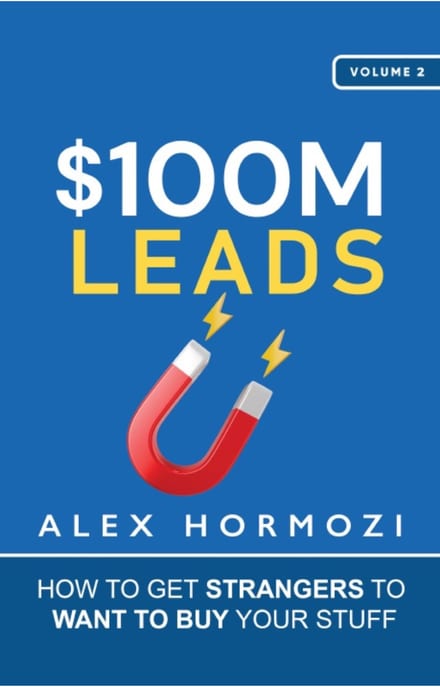
$100M Leads: How to Get Strangers to Want to Buy Your Stuff
How to Get Strangers to Want to Buy Your Stuff
The key ideas
- Count a lead only when someone shows interest, not when you own their email.
- Give away a complete solution to a narrow problem, better than other people's paid stuff.
- Work the Core Four in order: warm outreach, content, cold outreach, paid ads.
- Commit to the Rule of 100 — a hundred a day for a hundred days.
- Scale in strict order: more of what works, then better, then new.
- Recruit lead getters — customers, staff, agencies, affiliates — once you are the ceiling.
The summary
An offer nobody hears about earns nothing. That’s the gap Alex Hormozi set out to close after $100M Offers — that book taught you to build something people would feel stupid saying no to, and left open the harder question of who you say it to. His answer starts with a deflating redefinition. Advertising isn’t a creative discipline. It’s letting known people know about your stuff, over and over, and the line he builds the whole book on is that doubling your leads doubles your business.
Most of what people call a lead isn’t one
A lead, in his definition, is simply a person you can contact — a number, an email, a handle. On its own it’s worth close to nothing, which is why bought lists disappoint everyone who buys them. What you actually want is an engaged lead: someone who has shown interest in the thing you sell. They gave you their details on your page, replied to the email, booked the call, answered the message. That small act is the entire difference, and it’s what advertising is supposed to produce.
The redefinition changes what you measure. Impressions and follower counts stop counting. Replies, opt-ins and booked calls start. It also explains why the book reads like an operations manual: Hormozi’s companies produce over 20,000 new leads a day across sixteen industries, and none of it runs on inspiration.
Give away something you could have charged for
The bridge between a stranger and an engaged lead is a lead magnet, which he defines tightly: a complete solution to a narrow problem. Both words carry weight. Narrow, because solving one small problem properly surfaces the next problem, and the next problem is what you sell. Complete, because a deliberately crippled freebie teaches people that your paid thing is crippled too.
The forms are unglamorous — a calculator or spreadsheet, a short course, a free audit, a physical sample. What matters is the bar he sets: your free stuff should be better than other people’s paid stuff. Most people who take it will never buy anything. They will, however, form their opinion of you from it and tell other people, and that’s the return. So it gets a real name, gets tested, gets made easy to consume, and ends with an obvious next step.
There are only four ways to tell anyone anything
This is the spine of the book, and it’s brutally short. You can reach out to people who know you, post free content, reach out to strangers, or run paid ads. Warm outreach, content, cold outreach, ads — the Core Four. Everything else is a variation on one of them.
The order matters more than the list. Most people want to start with ads, and ads are where a beginner loses money fastest. Hormozi makes you exhaust the people who already trust you first, then content, then cold outreach, then paid — cheapest and warmest to most expensive and coldest. And then he attaches the Rule of 100: every day, do one hundred reach-outs, or spend a hundred minutes making content, or spend a hundred dollars on ads. Every day for a hundred days. It’s less a tactic than a filter. It separates people who want a business from people who want a strategy.
Volume first, optimization second, novelty last
Once something works, scaling it follows a fixed order — more, better, new. Do more of what’s already working before you touch anything else, because below roughly a million dollars of annual profit you don’t have enough data for optimization to pay. Above it, better starts to earn its keep: find the constraint, usually somewhere at the front end in the headline, the image, the landing page, and test one variable at a time. Only when more and better are exhausted do you go looking for new — a new placement first, then a new platform, then a new Core Four activity altogether.
Two mechanics hold the machine together. Ads have an anatomy — a callout that stops the right person, the value itself, and a call to action explicit enough to be followed without thinking. Because the callout does most of the work, you test it cheaply: thirty callouts against ten ads gives you three hundred combinations to sort through. And the constraint on how fast you can scale is arithmetic, not ambition. If a customer pays you more in their first thirty days than it cost to acquire and serve them, growth funds itself. He wants lifetime gross profit running at more than three times what you pay to acquire a customer.
Then stop being the one doing it
The ceiling on all of this is you. Hormozi’s fix is what he calls lead getters — not more activities but other people running the Core Four on your behalf. Customers who refer, employees you hire to do outreach, agencies you rent expertise from, and affiliates who put you in front of an audience they already own. Each is a separate playbook, and the switch is where a personal hustle becomes a company.
His management instinct fits: pay attention to outcomes, not hours. The gym example is a sales team that set its own schedule as long as it signed up five new members a day, no matter what.
The bottom line
Lead generation is a volume problem before it’s a cleverness problem, and the four channels are so few that your real choice is which one to do relentlessly. Be clear-eyed about the packaging, though: this is a direct-response playbook written loud, the numbers are Hormozi’s own results rather than research, and the whole thing doubles as the entrance to his business — which is why the frameworks are all free on his website.
Read it if you have something worth selling and no reliable way to find buyers. Skip it if your problem is the offer, not the audience — start with the other book.
Fact check
Popular books repeat findings that later research has complicated. Where $100M Leads makes a testable claim, here's what the evidence actually shows.
Doubling your leads doubles your business.
As arithmetic it is true only if conversion rate, order value and margin all hold steady while volume doubles, and the marketing evidence is that they do not — the response curve bends. A meta-analysis of 751 short-term and 402 long-term brand advertising elasticities drawn from 56 studies published between 1960 and 2008 puts the average short-term elasticity at 0.12 and the long-term at 0.24, meaning a 1% increase in advertising buys roughly a tenth of a percent more sales. Because response is concave, the second half of the leads costs considerably more than the first, and the marginal lead converts worse than the average one. The line is a useful way to make a business owner count leads at all; it is not a scaling law.
- Sethuraman R, Tellis GJ, Briesch RA. How Well Does Advertising Work? Generalizations from Meta-Analysis of Brand Advertising Elasticities. Journal of Marketing Research. 2011;48(3):457-471. Source
Beginners should exhaust warm outreach and free content before running paid ads, because ads are where an inexperienced advertiser loses money fastest.
A randomized field experiment at eBay found that brand-keyword search ads produced no measurable short-term benefit, and that once frequent buyers who would have purchased anyway were separated out, average returns to paid search were negative — the experimental estimates came to a fraction of the conventional non-experimental ones. A separate comparison across 15 US advertising experiments at Facebook, covering 500 million user-experiment observations and 1.6 billion impressions, found that the observational methods advertisers normally use often fail to recover the effect the randomized version measures. Both point the same way: the dashboard a beginner reads to decide whether ads are working systematically flatters them.
- Blake T, Nosko C, Tadelis S. Consumer Heterogeneity and Paid Search Effectiveness: A Large Scale Field Experiment. NBER Working Paper No. 20171. National Bureau of Economic Research, 2014. Source
- Gordon BR, Zettelmeyer F, Bhargava N, Chapsky D. A Comparison of Approaches to Advertising Measurement: Evidence from Big Field Experiments at Facebook. Marketing Science. 2019;38(2):193-225. Source
The Rule of 100 — a hundred outreaches, a hundred minutes of content or a hundred dollars of ads every day for a hundred days — is what separates people who build a business from people who collect strategies.
Sustained effort does predict outcomes, but far more weakly than a rule stated this confidently implies. A meta-analysis of 584 effect sizes from 88 independent samples covering 66,807 people found grit only moderately related to performance and retention, very strongly correlated with conscientiousness rather than distinct from it, and concluded that interventions designed to raise grit are likely to have weak effects. The one part that held up is the part the Rule of 100 targets: perseverance of effort predicted performance better than consistency of interest, and kept explaining variance after conscientiousness was controlled for. The specific numbers are Hormozi's own prescription, not a research finding.
- Credé M, Tynan MC, Harms PD. Much ado about grit: A meta-analytic synthesis of the grit literature. J Pers Soc Psychol. 2017;113(3):492-511. PubMed
Frequently asked questions
What is $100M Leads about?
It's the companion to $100M Offers: that book built something people would feel stupid saying no to, and this one answers who you say it to. Alex Hormozi's definition of advertising is deliberately deflating — letting known people know about your stuff, over and over — and the whole book rests on the line that doubling your leads doubles your business.
What are the key takeaways from $100M Leads?
A lead is just someone you can contact and is worth close to nothing; what you want is an engaged lead, someone who has shown interest by opting in, replying or booking a call, which shifts what you measure from impressions and followers to replies and bookings. The bridge to them is a lead magnet — a complete solution to a narrow problem, with the bar set at your free stuff being better than other people's paid stuff. There are only four ways to tell anyone anything, the Core Four: warm outreach, content, cold outreach, paid ads, worked in that order from cheapest and warmest to most expensive and coldest, because ads are where a beginner loses money fastest. The Rule of 100 attaches the volume — a hundred reach-outs, a hundred minutes of content or a hundred dollars of ads every day for a hundred days. Scaling follows more, better, new in that order, ads break down into a callout, the value and a call to action (test thirty callouts against ten ads for three hundred combinations), lifetime gross profit should run above three times acquisition cost, and the ceiling is you until you hand the Core Four to lead getters: customers who refer, employees, agencies and affiliates.
Who should read $100M Leads?
Read it if you have something worth selling and no reliable way to find buyers. Skip it if your problem is the offer rather than the audience — start with $100M Offers instead.
Is $100M Leads worth reading?
It reads like an operations manual rather than a motivational book, and the Core Four is short enough that your real decision becomes which channel to do relentlessly instead of which one to research. Be clear-eyed about the packaging: it's a direct-response playbook written loud, the numbers are Hormozi's own results rather than research, and the book doubles as the entrance to his business, which is why the frameworks are all free on his website.