Book summary
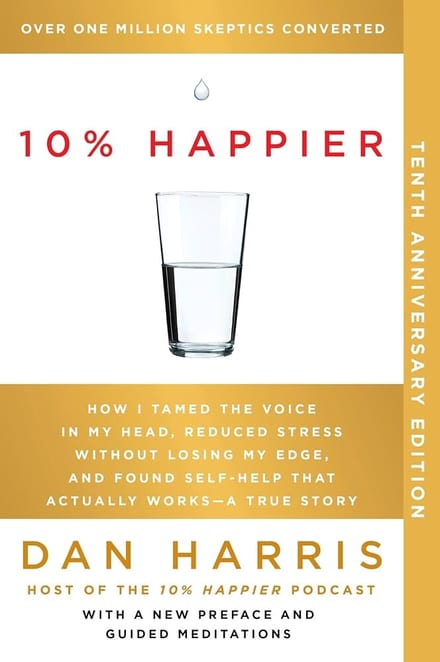
10% Happier
How I Tamed the Voice in My Head, Reduced Stress Without Losing My Edge, and Found Self-Help That Really Works – a True Story
The full book runs ~256 pages — roughly 5 hours of reading. You get the key ideas here in 3 minutes.
The key ideas
- Recognize the inner voice as story, not reality
- Observe emotions without obeying them — a fourth option
- Name it, allow it, feel it, detach from it
- Meditation literally grows gray matter, shrinks stress
- Taming the ego sharpens creativity, not softens edge
- Metta meditation builds compassion that improves decisions
The summary
The voice in your head never stops talking. It judges, replays yesterday’s mistakes, rehearses tomorrow’s arguments, and keeps insisting that happiness is one achievement away. Dan Harris spent years listening to it — chasing the next story, the next promotion, numbing the stress with drugs — until it caught up with him in the worst possible place: live on national television, mid-broadcast, in front of millions of viewers. The panic attack that followed sent this hardened, skeptical news anchor looking for a fix, and he found one where he least expected it. Not transcendence, not a cure. Just meditation, and a modest promise: about ten percent happier.
The ego is never satisfied by design
The narrator in your head is what most traditions call the ego. Forget Freud’s referee between morality and base desire; the useful definition is simpler — it’s the inner voice that guides your behavior, and it is insatiable. No matter what you get, it resets the baseline and demands more. Wealthy people crave more wealth. Beautiful people agonize over their looks. You land the promotion and the glow fades within a week. Meanwhile the ego keeps you out of the present, stewing over a fight with your spouse or losing sleep over retirement. The twist Harris had to swallow is that this whole self is something the brain manufactures — an illusion. Meditation doesn’t delete it, but it lets you see it for what it is: a story, not the truth. Once you stop believing everything your mind tells you, you get some room to breathe.
Observe without obeying
Sit comfortably and focus on your breath — the seated stillness Zen tradition calls zazen. That’s the entire technique, and you can do it anywhere. What it trains is the ability to watch a thought or feeling without being yanked around by it. Buddhist teaching says we react to the world in three automatic ways: we want (crave the food), we reject (swat the bug), or we zone out (tune out the dull lecture). Mindfulness adds a fourth option — observe without judgment. You notice the craving or the irritation, and you simply don’t act on it.
This is not repression. Harris tried repression, with substances, and it ended in that on-air collapse. The alternative is a four-step move he used when a promotion had him spiraling. Name the feeling (“I’m stressed”). Let it be (“it’s okay to feel this”). Watch its physical effects (the tight chest, the palpitations). Then separate from it (“this is temporary, not who I am”). Stuck in a long grocery line, you run the same play: notice the frustration, watch it, let it pass. You stay calm not because you’ve risen above annoyance but because you’ve stopped taking the feeling as a command. The only way out is through.
Meditation rewires the brain
Harris didn’t buy any of this until he saw the studies. Regular practice increases gray matter in regions tied to compassion and self-awareness, and shrinks the areas linked to stress. Meditators show more empathy, laugh more, and use the word “I” less. People who practice self-compassion meditation make healthier choices — eating better, quitting smoking — because accepting your flaws beats punishing yourself for them. The physical list keeps going: lower blood pressure and cardiovascular risk, help with depression and addiction, relief from asthma, psoriasis, ADHD, and irritable bowel syndrome, less loneliness, more patience and impulse control. For a born cynic, the evidence was too solid to wave away.
Taming the ego doesn’t cost you your edge
Harris’s real fear was that going soft would make him a pushover — unproductive, creatively flat, out of the game. The opposite happened. On a meditation retreat, cut off from his usual noise, he generated more good ideas than he ever had at his desk. Clearing mental clutter makes room for new thinking. It turns out controlling an urge can be more satisfying than indulging it, and you don’t need cranked-up stress or constant competition to do well — those things usually just get in the way. Even the touchy-feely part earns its keep. Metta meditation, silently repeating “may you be happy, may you be healthy, may you be safe” for yourself, for someone you’re fighting with, and for everyone, builds a compassion that sharpens decisions rather than dulling them.
The bottom line
A few minutes a day of watching your thoughts instead of obeying them buys enough distance to step off the ego’s treadmill and respond instead of react. It won’t make you enlightened, and it isn’t supposed to — ten percent is the honest, repeatable win. Read this if you’re allergic to self-help but exhausted by the voice in your head running the show.
Fact check
Popular books repeat findings that later research has complicated. Where 10% Happier makes a testable claim, here's what the evidence actually shows.
Regular meditation grows gray matter in regions tied to compassion and self-awareness and shrinks the stress-linked amygdala.
The best-powered test of this found nothing. Two combined randomized trials assigned 218 meditation-naive adults to an eight-week mindfulness-based stress reduction course, an active control course, or a waitlist, and found no change in gray matter volume, gray matter density or cortical thickness — neither across the whole brain nor in the specific regions earlier studies had flagged. The finding Harris was persuaded by came from a 2011 study of 16 MBSR participants against 17 controls, reporting increased gray matter density in the hippocampus and posterior cingulate. That result has not held up at scale.
- Kral TRA, Davis K, Korponay C, et al. Absence of structural brain changes from mindfulness-based stress reduction: two combined randomized controlled trials. Sci Adv. 2022;8(20):eabk3316. PubMed
- Hölzel BK, Carmody J, Vangel M, et al. Mindfulness practice leads to increases in regional brain gray matter density. Psychiatry Res. 2011;191(1):36-43. PubMed
Meditation lowers blood pressure and cardiovascular risk.
A meta-analysis of 19 randomized trials found blood pressure reductions in the range of 2.5 to 5.6 mmHg systolic and 2.2 to 4.3 mmHg diastolic, varying by meditation style and measurement method — and the systolic effect for transcendental meditation under 24-hour ambulatory monitoring, the most rigorous measurement, was not statistically significant. The American Heart Association's own review concluded meditation may be considered as an adjunct to standard risk reduction, while stating plainly that the quality and quantity of the data are modest and the benefit remains to be established. So a small real effect on blood pressure, not the cardiovascular protection the phrasing suggests.
- Shi L, Zhang D, Wang L, Zhuang J, Cook R, Chen L. Meditation and blood pressure: a meta-analysis of randomized clinical trials. J Hypertens. 2017;35(4):696-706. PubMed
- Levine GN, Lange RA, Bairey-Merz CN, et al. Meditation and cardiovascular risk reduction: a scientific statement from the American Heart Association. J Am Heart Assoc. 2017;6(10):e002218. PubMed
Meditation relieves depression, addiction, asthma, psoriasis, ADHD and irritable bowel syndrome.
A review of 47 randomized trials covering 3,515 participants found moderate evidence that mindfulness meditation improves anxiety (effect size 0.38 at eight weeks), depression (0.30) and pain (0.33) — modest but genuine, roughly what an antidepressant delivers. For substance use, sleep, eating habits and weight the same review found low or insufficient evidence, and it found no evidence that meditation programs outperformed active comparators such as exercise, drugs or behavioural therapy. The depression entry on Harris's list holds up at that modest strength; the rest of the catalogue runs ahead of what the trial evidence supports.
- Goyal M, Singh S, Sibinga EM, et al. Meditation programs for psychological stress and well-being: a systematic review and meta-analysis. JAMA Intern Med. 2014;174(3):357-68. PubMed
Practising self-compassion leads to healthier behaviour, such as eating better and quitting smoking.
Pooling 94 studies and 29,588 participants, self-compassion correlated r = .26 with health behaviour and r = .18 with physical health, with the strongest links to sleep, immune function and avoiding risky situations. It did not predict substance abuse — which is where smoking cessation sits — nor frailty or maladaptive bodily routines. Multi-session interventions produced significant effects while single-session inductions did not, so the mechanism looks real but needs sustained practice, and the smoking example is the weakest part of the claim.
- Phillips WJ, Hine DW. Self-compassion, physical health, and health behaviour: a meta-analysis. Health Psychol Rev. 2021;15(1):113-139. PubMed
Frequently asked questions
What is 10% Happier about?
A skeptical news anchor has a panic attack live on national television, then goes looking for a fix and finds meditation, which he came to see as a modest but real edge, about ten percent happier. The book is his account of quieting the restless voice in his head without turning into a mystic.
What are the key takeaways from 10% Happier?
The ego is the insatiable inner narrator that always resets the baseline and demands more, and meditation lets you see it as a story rather than the truth. The core practice is simple: focus on your breath and observe thoughts without obeying them, adding a fourth option beyond wanting, rejecting, and zoning out. A four-step move, name the feeling, let it be, watch its physical effects, then separate from it, handles stress in real time. The research on more gray matter, less stress, and greater compassion is what won over a born cynic, and taming the ego doesn't cost you your competitive edge.
Who should read 10% Happier?
It's for people who are allergic to self-help but exhausted by the voice in their head running the show, and who want an evidence-based, no-nonsense case for meditation.
Is 10% Happier worth reading?
Its strength is the skeptic's framing, honest, funny, and backed by studies, so the promise stays modest and believable rather than grandiose. Experienced meditators may find the actual technique thin, and anyone wanting a step-by-step manual will get more memoir and persuasion than detailed instruction.