Book summary
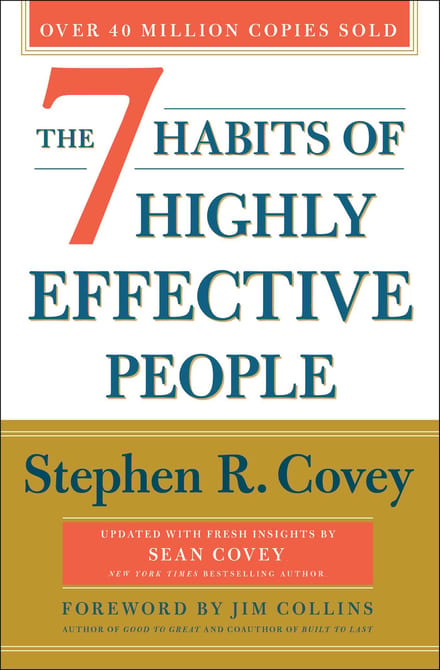
The 7 Habits of Highly Effective People
The full book runs ~374 pages — roughly 7 hours of reading. You get the key ideas here in 6 minutes.
The key ideas
- Choose your response; focus on what you control
- Define your mission before you take action
- Prioritize important-but-not-urgent tasks over busywork
- Seek win-win solutions built on mutual trust
- Listen to understand before demanding to be understood
- Renew body, mind, spirit, and relationships regularly
The summary
You can master every communication technique ever taught and still fail, because durable effectiveness doesn’t come from surface tricks. It comes from character, and from the paradigm — the lens — through which you see the world. Covey draws a line between two routes to change. The personality ethic teaches the behaviors you want, like studying body language to get along with people. The character ethic works on the fundamental habits and beliefs that shape your worldview, and its results endure. The seven habits carry you from private victory over yourself to public victory with others.
Covey learned how fast a paradigm can shift on a New York subway. A father let his children run wild while he sat with his eyes shut. Irritated, Covey asked him to control them. The man explained that the children’s mother had died an hour earlier and they were all in shock. Annoyance turned to compassion instantly. Aiming your paradigms toward universal qualities like fairness, honesty, and integrity is the whole point of the habits.
You choose your response
Animals are slaves to stimulus. Humans can pause and reflect before they react. Reactive people fixate on their circle of concern — bills, distant wars, things they can’t touch — while proactive people work inside their circle of influence, which grows the more they use it. Viktor Frankl, imprisoned across several concentration camps, chose hope and a future in which he’d teach the world what he’d seen. That inner freedom, the one thing his captors couldn’t seize, kept him alive and lifted the people around him. Try Covey’s 30-day challenge: every time you catch yourself blaming a circumstance or another person, remind yourself the real issue is how you’re choosing to respond.
Know where you’re going, then guard the road
Every action happens twice — first in your mind, then in reality — which is why athletes rehearse the details before they perform. Being efficient means doing the most in the least time. Being effective means moving toward what actually matters. You can climb the ladder at record speed and still have it leaned against the wrong wall. Picture your own funeral and ask what you’d want people to say about you; then write a personal statement of your values and the person you intend to become.
Protecting that direction is a matter of priorities. Sort your tasks by two dimensions, urgency and importance, and you get four quadrants. Most people drown in quadrant one crises and quadrant three interruptions while neglecting quadrant two — important but not urgent work like building relationships and planning ahead. That quadrant is where the outsized returns hide. Covey’s shopping-center managers knew relationships with store owners mattered most, yet spent under 5% of their time on them. When they committed a third of their time instead, client satisfaction and lease revenue both climbed. The more you live in quadrant two, the fewer crises land in quadrant one.
Win with people, not against them
Many people carry a win-lose worldview that turns every interaction into a contest and often produces lose-lose. The win-win paradigm looks for outcomes that leave everyone better off, and it runs on trust. You build that trust by funding “emotional bank accounts” — keeping promises, listening without an agenda, being explicit about expectations, staying courteous in small things. One of Covey’s friends took his son on a six-week road trip to see every major-league team play. Asked whether he loved baseball that much, he said, “No, but I like my son that much.”
Trust also depends on listening. Most of us listen in order to reply, projecting our own perspective and prescribing solutions before we understand the problem. Empathetic listening means shifting to “I’m listening so I can really understand,” and paying attention to feeling and behavior, since words carry only about 10% of a message, tone 30%, and body language the rest. From there comes synergy, where the whole exceeds its parts and one plus one can reach three. David Lilienthal, running the Atomic Energy Commission after the war, spent the group’s first weeks simply getting people to know and trust one another. Critics called it inefficient. The respectful, productive culture it created proved them wrong.
Sharpen the saw
None of this holds if you let yourself run down. Tend your physical health by eating well, exercising, and avoiding needless stress. Keep your spiritual health through prayer, meditation, and reflection on your values. Stay mentally sharp by reading good work and writing. Build your social and emotional health through relationships and empathy. Effectiveness isn’t a sprint; it’s a way of living that has to be renewed.
The bottom line
Effectiveness is built from the inside out: master your own responses, get clear on what matters, prioritize it ruthlessly, then carry that character into how you treat other people. Read this if you want a framework for growth that starts with who you are rather than what you say.
Fact check
Popular books repeat findings that later research has complicated. Where The 7 Habits of Highly Effective People makes a testable claim, here's what the evidence actually shows.
Words carry only about 10% of a message, tone about 30%, and body language the rest.
The famous split traces to two 1967 experiments by Albert Mehrabian, and neither measured how much meaning ordinary speech carries. In one, listeners heard a single spoken word delivered in a tone that deliberately clashed with its meaning and judged whether the speaker liked them; in the other, a photographed facial expression was pitted against a vocal tone, splitting 3 to 2. Combining those two narrow results yields the 7/38/55 figures that circulate as a law of communication — not the 10/30/60 the summary gives, and not a finding about normal conversation at all. Mehrabian's own caveat was that the ratio applies only to inconsistent messages about feelings and attitudes.
- Mehrabian A, Wiener M. Decoding of inconsistent communications. J Pers Soc Psychol. 1967;6(1):109-14. PubMed
- Mehrabian A, Ferris SR. Inference of attitudes from nonverbal communication in two channels. J Consult Psychol. 1967;31(3):248-52. PubMed
- Lapakko D. Three cheers for language: a closer examination of a widely cited study of nonverbal communication. Communication Education. 1997;46(1):63-67. Source
Mentally rehearsing an action before you do it improves your actual performance.
Mental practice does help, but modestly: a meta-analysis of 37 studies published between 1995 and 2018 put the average effect at r = 0.13. How long people rehearse, what kind of task it is, and what kind of imagery they use all change the result, so the benefit is conditional rather than automatic. Covey's point that rehearsal precedes execution is directionally right; the evidence does not support treating it as a substitute for doing the thing.
- Toth AJ, McNeill E, Hayes K, Moran AP, Campbell M. Does mental practice still enhance performance? A 24 year follow-up and meta-analytic replication and extension. Psychol Sport Exerc. 2020;48:101672. Source
Deliberately managing your time toward important-but-not-urgent work pays off in performance.
Across 158 studies and 490 effect sizes covering 53,957 people, time management correlates with work performance at about r = .25 — real, but moderate. The larger payoff is in how people feel: the correlation with life satisfaction reached r = .39, well above the r = .23 for job satisfaction, and time management related negatively to psychological distress. Covey's specific urgent/important quadrant scheme has not been tested as a standalone intervention, so the meta-analytic evidence supports the general practice rather than his particular framework.
- Aeon B, Faber A, Panaccio A. Does time management work? A meta-analysis. PLoS One. 2021;16(1):e0245066. PubMed
Frequently asked questions
What is The 7 Habits of Highly Effective People about?
It argues that durable effectiveness comes from character and from the paradigm, or lens, through which you see the world, not from surface tricks and techniques. The seven habits move you from private victory over yourself to public victory with others, built from the inside out.
What are the key takeaways from The 7 Habits of Highly Effective People?
Be proactive by working inside your circle of influence rather than fixating on your circle of concern. Begin with the end in mind by writing a personal statement of your values. Put first things first using the urgency-importance quadrants, spending more time in quadrant two, important but not urgent. Think win-win and fund "emotional bank accounts" of trust. Seek first to understand through empathetic listening, then be understood. Synergize so the whole exceeds its parts. And sharpen the saw by renewing yourself physically, spiritually, mentally, and socially.
Who should read The 7 Habits of Highly Effective People?
It's for anyone who wants a framework for growth that starts with who they are rather than what they say, and who prefers character-based change over quick behavioral tactics.
Is The 7 Habits of Highly Effective People worth reading?
It endures because its principles, like separating urgency from importance and listening to understand rather than to reply, are genuinely foundational and reinforced with memorable stories such as the subway father. Readers who want fast, tactical hacks may find its inside-out, character-first approach slow and abstract, since the payoff comes from steady practice rather than a quick fix.