Book summary
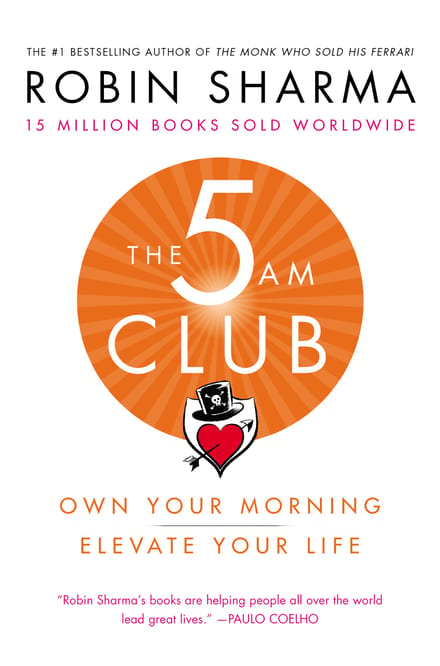
The 5 AM Club: Own Your Morning. Elevate Your Life
The full book runs ~360 pages — roughly 7 hours of reading. You get the key ideas here in 3 minutes.
The key ideas
- Claim 5am: distraction-free focus while your brain peaks for flow
- Run the 20/20/20: move, reflect, then grow
- Build four empires: mindset, heartset, healthset, soulset
- Push through 66 days of hard, messy, then automatic rewiring
- Protect focus with 90/90/1 and 60/10 work rhythms
- Oscillate between intense output and deep evening recovery
The summary
The hour right after you wake is the only stretch of the day nobody else has a claim on. Your inbox is still quiet, nobody has texted, and the people who want a piece of you are asleep. Robin Sharma’s whole case rests on that fact: you are at your most focused, creative, and productive in the first hour after waking, so whoever owns that hour owns the day. There’s biology underneath it too. At 5am your prefrontal cortex is running at half power, which shields you from stress and overthinking, while dopamine and serotonin climb and prime you to slip into flow — that state of energized concentration where the real work gets done. As the day wears on, work, news, people, and devices carve up your mental bandwidth until almost nothing is left for deep attention. The morning is your one clean shot, and Tim Cook, John Grisham, Frank Lloyd Wright, Hemingway, and Mozart all seized it before the rest of the world was moving. “Take excellent care of the front end of your day, and the rest of your day will pretty much take care of itself.”
The 20/20/20 hour
Sharma turns the idea into a fixed routine: split that first hour into three twenty-minute blocks. First, move. Exercise hard enough to burn off cortisol, the hormone of stress and fear, and to produce BDNF, a protein that helps the brain build new connections, repair its cells, and think more clearly. Next, reflect. Write down what you’re grateful for, what you’re aiming at, what’s frustrating you, and meditate to bring cortisol down further. Finally, grow — read a biography, study psychology or business or your own field, feed the mind something that stretches it.
Behind the routine sits a larger goal: building what Sharma calls the four interior empires. Mindset is your attitude toward life, because what you believe you can achieve shapes what you actually achieve. Heartset is your emotional health, and emotions you refuse to express tend to resurface later in uglier forms. Healthset is your physical vitality, which exercise feeds by lifting energy and mood and lowering stress. Soulset is your sense of connection to yourself and the world, deepened through stillness and meditation. Neglect any one of them and the routine loses its point.
Willpower is built, not born
Discipline, in Sharma’s telling, beats natural talent every time — so capitalize on the abilities you have and stop stewing over the ones you don’t. And discipline is not a gift you either got or didn’t. It’s a muscle: the more you activate it, the stronger it grows, and like any muscle it needs recovery to recharge. His 5-3-1 creed compresses the science. The five truths: willpower is developed rather than innate, discipline strengthens with use, it needs rest, forming a habit takes a process and not just a wish, and discipline in one area bleeds into every other. The three values: success requires consistency and persistence, you earn respect by finishing what you start, and the discipline you keep in private will show in public. The one master principle: regularly do what is hard and important, not what is easy or convenient.
Change is messy before it’s automatic
Knowing the routine is easy; surviving the rewiring is not. Sharma maps it across 66 days in three 22-day stages. In deconstruction, your brain fights to keep you from doing anything new and uncomfortable, so this stage runs on raw discipline — “world-class begins where your comfort zone ends.” In installation, neurons are busy laying down the new pathway, which leaves you anxious, confused, and tempted to quit; the work is to stay put and trust that you’re mid-transformation. In integration, continued practice paves and cements the pathway until the behavior costs you nothing at all. As Sharma puts it, “all change is hard at first, messy in the middle and gorgeous at the end.” This is also why the small things win: the smallest implementation beats the grandest intention, ten minutes saved a day adds up to more than sixty hours a year, and mastery tends to arrive after roughly ten years of 2.75-plus hours of daily practice.
Guard the assets, then recover hard
Your five primary assets — mental focus, physical energy, personal willpower, talent, and daily routine — are all strongest in the early morning, which is exactly why the hour is worth protecting. Sharma’s tactics for the rest of the day are blunt about defending them. Keep a tight bubble of total focus and refuse the news, ads, and idle chatter that drain you cognitively, spiritually, and financially. Run the 90/90/1 rule: for the next ninety days, spend the first ninety minutes of work on the single project that would let you dominate your field. Work in 60/10 intervals of full concentration and short rest, and delegate the tasks you dislike rather than letting them eat your best energy.
Then stop. The best performers oscillate between intense output and genuine recovery, the way a field blossoms after a fallow season restores its nutrients — Sharma calls it the Twin Cycles of Elite Performance, peak work in the morning and recharging in the evening. Recovery isn’t optional maintenance; it’s what makes the next cycle possible. Treat the night as seriously as the dawn: cut screens after 8pm, since blue light suppresses the melatonin that makes you sleepy, and be asleep before 10pm, because sleep quality is tied to longevity.
The bottom line
Win the first hour and the rest of the day tends to fall into place — but only if you survive the roughly two months of hard, messy rewiring it takes for the routine to run on its own. Read this if you’re ready to trade grand intentions for a small daily discipline and want a concrete blueprint for the trade.
Fact check
Popular books repeat findings that later research has complicated. Where The 5 AM Club makes a testable claim, here's what the evidence actually shows.
At 5am the prefrontal cortex is running at half power, which shields you from stress and overthinking while dopamine and serotonin climb.
The measured pattern runs the other way. Cortisol — the stress hormone the routine is meant to avoid — surges across the first 30 to 45 minutes after waking in healthy people, the largest cortisol burst of the day, mobilising resources for the hours ahead. The stretch right after waking is also when executive function is worst, not best: sleep inertia produces measurable performance impairment and sleepiness, and is most intense when you wake during the biological night, which is what a 5am alarm means for many people. Early focused work can still pay off, but the reason is an empty inbox and a quiet house, not a half-powered brain.
- Stalder T, Oster H, Abelson JL, Huthsteiner K, Klucken T, Clow A. The Cortisol Awakening Response: Regulation and Functional Significance. Endocr Rev. 2025;46(1):43-59. PubMed
- Trotti LM. Waking up is the hardest thing I do all day: Sleep inertia and sleep drunkenness. Sleep Med Rev. 2017;35:76-84. PubMed
Installing a new habit takes 66 days, running through three fixed 22-day stages.
The 66 days is real but it is a median, not a schedule. In the study behind it, 96 people adopting a daily behaviour took a median of 66 days to reach near-maximum automaticity, with individuals landing anywhere from 18 to 254 days depending on the person and the habit. Its lead author has since said the figure should not be read as a rule, and that the actual finding was how variable habit formation is. The tidy split into three 22-day phases is the book's own framing — the automaticity curves the study fitted climb gradually toward a plateau, with no stage boundaries in the data.
Mastery arrives after roughly ten years of 2.75-plus hours of daily practice.
Practice matters, but not nearly enough to support a threshold like this. A meta-analysis of 88 studies found deliberate practice explained 26% of the variance in performance for games, 21% for music, 18% for sports, 4% for education and under 1% for professions — leaving most of the difference between people to other factors. A 2019 pre-registered replication of the violinist study that seeded the ten-year rule confirmed better players had practised more, but found the effect considerably smaller than originally reported, and no advantage for teacher-designed practice over practising alone.
- Macnamara BN, Hambrick DZ, Oswald FL. Deliberate practice and performance in music, games, sports, education, and professions: a meta-analysis. Psychol Sci. 2014;25(8):1608-18. PubMed
- Macnamara BN, Maitra M. The role of deliberate practice in expert performance: revisiting Ericsson, Krampe & Tesch-Römer (1993). R Soc Open Sci. 2019;6(8):190327. PubMed
Cut screens after 8pm because blue light suppresses melatonin, and be asleep before 10pm because sleep timing is tied to longevity.
The screen half holds up well. In a controlled crossover trial, reading on a light-emitting tablet in the hours before bed cut evening melatonin by about 55%, pushed melatonin onset more than 1.5 hours later, and added roughly 10 minutes to falling asleep compared with a printed book. The bedtime half runs the wrong way. Across 103,712 UK Biobank participants with accelerometer-measured sleep, onset between 10:00 and 10:59pm carried the lowest cardiovascular disease incidence — and falling asleep before 10pm was associated with 24% higher incidence (HR 1.24, 95% CI 1.10-1.39), a penalty in the same direction as going to bed too late.
- Chang AM, Aeschbach D, Duffy JF, Czeisler CA. Evening use of light-emitting eReaders negatively affects sleep, circadian timing, and next-morning alertness. Proc Natl Acad Sci U S A. 2015;112(4):1232-7. PubMed
- Nikbakhtian S, Reed AB, Obika BD, Morelli D, Cunningham AC, Aral M, Plans D. Accelerometer-derived sleep onset timing and cardiovascular disease incidence: a UK Biobank cohort study. Eur Heart J Digit Health. 2021;2(4):658-666. PubMed
Frequently asked questions
What is The 5 AM Club about?
It argues that the first hour after waking is the only stretch of the day nobody else can claim, and that you're at your most focused and creative then, so whoever owns that hour owns the day. Robin Sharma builds a whole morning routine and life philosophy around rising at 5am and protecting that early window.
What are the key takeaways from The 5 AM Club?
The centerpiece is the 20/20/20 formula: split the first hour into twenty minutes of hard exercise, twenty of reflection, and twenty of learning. Underneath sits the goal of building four interior empires, Mindset, Heartset, Healthset, and Soulset. Discipline is treated as a muscle you strengthen with use, and real change is mapped over 66 days in three stages, described as "hard at first, messy in the middle and gorgeous at the end." For the rest of the day, Sharma adds the 90/90/1 rule, 60/10 work intervals, and the Twin Cycles of intense output paired with genuine recovery.
Who should read The 5 AM Club?
It's for people ready to trade grand intentions for a small daily discipline, who want a concrete blueprint for owning their morning and are willing to endure the roughly two months of rewiring it takes.
Is The 5 AM Club worth reading?
It's useful for the specific, science-flavored routine it hands you, the 20/20/20 hour, and for being honest that the habit is genuinely painful before it becomes automatic. Readers who dislike heavy repetition or a fable-style delivery may find it padded, and hardcore night owls will have to decide whether the pre-dawn premise fits their life at all.