Book summary
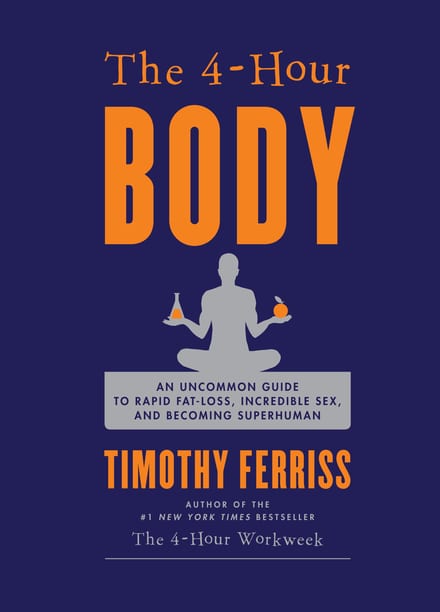
The 4-Hour Body
An Uncommon Guide to Rapid Fat-Loss, Incredible Sex, and Becoming Superhuman
The full book runs ~587 pages — roughly 11 hours of reading. You get the key ideas here in 5 minutes.
The key ideas
- Manage hormones, not just calories—not all calories are equal
- Eat slow carbs, repeat meals, binge one cheat day weekly
- Train minimally: brief kettlebell swings and low-volume, high-intensity lifting
- Boost testosterone via cod liver oil, vitamin D, cold exposure
- Prioritize sleep quality over duration with temperature and diet tweaks
- Track consistently—measurement builds awareness and changes behavior
The summary
Your body responds to what you eat at a hormonal level, not just a caloric one, and most of what happens in a gym is wasted effort. That single reframing sits underneath Timothy Ferriss’s decade of self-experiments, a project he spent more than $250,000 testing and refining. The aim was never to do more. It was to find the Minimum Effective Dose: the smallest change that produces the outcome you’re after. Push past that threshold and you often go backward.
The endurance athlete Brian MacKenzie makes the case. He cut his weekly training from as much as 30 hours down to 6.5 and got faster. The extra volume hadn’t been building fitness; it had been wrecking his body and his relationships. The same logic reaches everywhere. That hour on the Stairmaster burned roughly seven calories. Exercise barely touches the scale; diet does the work. And the calories themselves aren’t equal. In one study, 1,000 calories a day of 90% carbohydrate produced weight gain, while 1,000 calories of 90% fat produced weight loss. What your hormones do with protein, fat, and carbs matters more than the arithmetic. With the right training and nutrition, Ferriss argues, you can even override your genetic profile.
The Slow-Carb Diet
Ferriss’s plan for losing 20 pounds of fat in 30 days, without exercise, comes down to five rules:
- Avoid white carbohydrates — bread, rice, cereal, potatoes, pasta, anything breaded and fried.
- Eat the same few meals on repeat, built from approved proteins (eggs, chicken, beef), legumes (lentils, black beans), and vegetables (spinach, broccoli).
- Don’t drink calories: water, unsweetened tea or coffee, no more than two glasses of red wine a night.
- Skip fruit, since fructose converts to fat efficiently.
- Take one day off a week and binge on whatever you want.
That cheat day isn’t a lapse — it spikes your intake on purpose and keeps your metabolism from downshifting. The usual mistakes are eating too little protein (aim for 20 grams a meal), skipping breakfast when eating within an hour of waking would blunt carb cravings, and mindlessly grazing on “domino foods” like nuts. You can limit cheat-day fat gain by front-loading protein, using PAGG supplements, drinking grapefruit juice, and doing 60–90 seconds of air squats before and after meals to push glucose into muscle.
Train less, gain more
Forget long cardio. Tracy Reifkind lost over 100 pounds doing two-handed kettlebell swings twice a week, 15–20 minutes a session. Ferriss hit his lowest body fat in six years on one set of 75 swings, twice a week. Visible abs need body fat under 12% plus targeted work like the Myotatic Crunch on an exercise ball and the Cat Vomit Exercise — on hands and knees, exhale hard while pulling your navel toward your spine, hold, repeat.
Muscle follows the same minimalist logic. Occam’s Protocol alternates two workouts, one set per exercise taken to failure at a slow five-seconds-up, five-seconds-down cadence, with recovery stretching from every third day to every fifth as you grow. Casey Viator gained 63 pounds of muscle in 28 days on a related plan, fueled by enormous eating — often a gallon of milk a day. Raw strength is different again: it comes from neural adaptation, not size. Barry Ross had sprinters lift under 15 minutes a week — 2–3 reps at 85–95% of max on the deadlift and bench, with five-minute rests. One lifter added 100 pounds to his bench in six months this way.
Sex, testosterone, and sleep
Nearly every woman can orgasm, Ferriss reports, but it usually takes technique and psychological comfort. “No man can give you an orgasm. He can only help you do it yourself.” The practical advice: adjust angles so the G-spot is stimulated and the pelvic bone contacts the clitoris, and try 15 minutes of light, continuous stroking on the upper-left quadrant.
He more than doubled his own testosterone through fermented cod liver oil, vitamin D3, cold exposure, and Brazil nuts. Eating egg yolks before bed can give a short-term libido bump by syncing with the body’s overnight testosterone cycle. Sleep, meanwhile, is about quality — the share of REM and deep-wave sleep — not hours. A room at 67–70°F, a fatty high-protein meal within three hours of bed, morning blue-light exposure, and a ten-minute ice bath an hour before sleep all help you drop off faster.
Measurement is the real intervention
The thread running through all of it: tracking something consistently matters more than what you track, because the act of measuring creates the awareness that changes behavior. Make it a game. Commit to just five sessions of a new habit and you’re far more likely to keep going. Lean on public commitments and the fear of losing a bet. Start absurdly small — a five-minute workout instead of an hour. Lasting change, Ferriss says, needs a “Harajuku Moment,” the epiphany that turns a nice-to-have goal into a non-negotiable one. Programmer Chad Fowler had his when he heard the helplessness in his own voice describing his health, then lost 70 pounds.
The bottom line
Find the smallest dose that works, and stop there — more effort frequently sabotages the result. Then track it, because measurement alone starts to move you. Read this if you’re tired of grinding without payoff and willing to treat your own body as the experiment.
Fact check
Popular books repeat findings that later research has complicated. Where The 4-Hour Body makes a testable claim, here's what the evidence actually shows.
At equal calories, a mostly-carbohydrate diet produces weight gain while a mostly-fat diet produces weight loss, so hormones matter more than calorie arithmetic.
The figure traces to Kekwick and Pawan's 1956 Lancet study, in which obese patients held at 1,000 calories a day lost weight fastest on high-fat and slowest on high-carbohydrate diets. Controlled metabolic-ward work has since reversed the direction: when 19 adults with obesity had 30% of their calories cut either from fat or from carbohydrate, fat restriction produced 89 plus or minus 6 g/day of body fat loss against 53 plus or minus 6 g/day for carbohydrate restriction. Macronutrient composition does change fuel use and short-term water and glycogen balance, but at matched calories it does not turn weight gain into weight loss.
- Hall KD, Bemis T, Brychta R, et al. Calorie for Calorie, Dietary Fat Restriction Results in More Body Fat Loss than Carbohydrate Restriction in People with Obesity. Cell Metab. 2015;22(3):427-36. PubMed
- Kekwick A, Pawan GL. Calorie intake in relation to body-weight changes in the obese. Lancet. 1956;271(6935):155-61. PubMed
An hour on a stair machine burns only about seven calories, so exercise barely affects fat loss and diet does nearly all the work.
The conclusion holds up better than the arithmetic. Across 80 weight-loss trials with at least a year of follow-up, exercise-alone groups showed minimal weight loss at every time point, and a Cochrane review of 43 trials found that adding exercise to a diet bought only about 1.1 kg more than dieting alone. The seven-calorie figure, though, is off by roughly two orders of magnitude: the Compendium of Physical Activities rates a stair-treadmill ergometer at 9.3 METs, about 650 calories an hour for a 70 kg adult.
- Franz MJ, VanWormer JJ, Crain AL, et al. Weight-loss outcomes: a systematic review and meta-analysis of weight-loss clinical trials with a minimum 1-year follow-up. J Am Diet Assoc. 2007;107(10):1755-67. PubMed
- Shaw K, Gennat H, O'Rourke P, Del Mar C. Exercise for overweight or obesity. Cochrane Database Syst Rev. 2006;2006(4):CD003817. PubMed
- Ainsworth BE, Haskell WL, Herrmann SD, et al. 2011 Compendium of Physical Activities: a second update of codes and MET values. Med Sci Sports Exerc. 2011;43(8):1575-81. PubMed
Fermented cod liver oil, vitamin D3, Brazil nuts and cold exposure can more than double a man's testosterone.
No trial has produced anything near a doubling. The most favorable result comes from a year of 3,332 IU/day vitamin D in men enrolled in a weight-reduction program, where total testosterone rose from 10.7 to 13.4 nmol/L, about 25%. A later randomized trial in healthy middle-aged men with normal baseline levels found no treatment effect at all, and a meta-analysis of eight trials found no significant change in total testosterone (mean difference 0.20, 95% CI -0.20 to 0.60).
- Pilz S, Frisch S, Koertke H, et al. Effect of vitamin D supplementation on testosterone levels in men. Horm Metab Res. 2011;43(3):223-5. PubMed
- Lerchbaum E, Pilz S, Trummer C, et al. Vitamin D and Testosterone in Healthy Men: A Randomized Controlled Trial. J Clin Endocrinol Metab. 2017;102(11):4292-4302. PubMed
- Hosseini Marnani E, Mollahosseini M, Gheflati A, Ghadiri-Anari A, Nadjarzadeh A. The effect of vitamin D supplementation on the androgenic profile in men: A systematic review and meta-analysis of clinical trials. Andrologia. 2019;51(9):e13343. PubMed
A trainee gained 63 pounds of muscle in 28 days on a low-volume, high-intensity program.
The Colorado Experiment number describes regaining mass rather than building it: Casey Viator was returning to a physique he had already carried before a long layoff. Fibers that were once large regain size markedly faster than fibers that never grew, which is why men who took three-week breaks from bench-press training caught up with those who trained continuously across 24 weeks. Read as evidence of what the protocol can add to an ordinary body, 28 kg in a month does not transfer.
- Gundersen K. Muscle memory and a new cellular model for muscle atrophy and hypertrophy. J Exp Biol. 2016;219(Pt 2):235-42. PubMed
- Ogasawara R, Yasuda T, Ishii N, Abe T. Comparison of muscle hypertrophy following 6-month of continuous and periodic strength training. Eur J Appl Physiol. 2013;113(4):975-85. PubMed
Frequently asked questions
What is The 4-Hour Body about?
It makes the case that your body reacts to food at a hormonal level, not just a caloric one, so 1,000 calories of fat and 1,000 calories of carbs do very different things. Drawing on more than $250,000 of self-experiments, Tim Ferriss looks for the Minimum Effective Dose in each area of health: the smallest change that gets the result, since pushing past it often makes things worse.
What are the key takeaways from The 4-Hour Body?
The core ideas are the Minimum Effective Dose and the Slow-Carb Diet: avoid white carbs, eat the same few protein-and-legume meals on repeat, don't drink calories, skip fruit, and take one weekly cheat day to keep metabolism from slowing. On training, less is more, with two-handed kettlebell swings, Occam's Protocol for muscle, and short heavy deadlifts for strength. The thread tying it together is measurement: tracking a habit consistently creates the awareness that changes behavior, especially after a "Harajuku Moment" makes the goal non-negotiable.
Who should read The 4-Hour Body?
It's for people tired of grinding away at diet and exercise without payoff, who are willing to treat their own body as the experiment and measure the results rather than follow received wisdom.
Is The 4-Hour Body worth reading?
It's strong on the counterintuitive point that more effort often sabotages results, and it's packed with concrete, testable protocols like the five Slow-Carb rules and minimalist workouts. The flip side is that it's a grab-bag of personal experiments spanning fat loss, muscle, strength, sex, and sleep, so readers who want a single tidy program rather than a menu to tinker with may find it sprawling.